The Prototype Playbook: What It Actually Takes to Get From Prototype to Production
The Prototype Playbook: What It Actually Takes to Get From Prototype to Production
Developing a new product has a high failure rate. Most startups never make the transition from prototype to production, and a large share of the companies that do fail cite prolonged development timelines or poor product-market fit as the cause. The gap between a working prototype and a shippable product is where most of that time and money disappears.
OpusFab’s new Prototype Playbook lays out where that gap comes from and how founders and engineering teams can close it. This post summarizes the core points.
Where Prototyping Actually Goes Wrong
A few patterns show up repeatedly in product development:
- Manual quoting commonly takes two to three weeks for a full assembly, or three to five days per part.
- Every design change requires a new prototype to validate it.
- Each design loop compounds cost, with a reported 15 to 40% increase per iteration.
- Mismatched revision control wastes entire iterations when the wrong version of a part gets built.
These issues compound. A design change triggers a build, the build surfaces a new issue, the issue triggers another design change, and the cycle repeats. Without a tight process around quoting, revision control, and manufacturability review, each pass through this loop gets slower and more expensive.
Four Numbers to Know Before You Build
The Playbook highlights four figures that frame the stakes of the prototype-to-production process:
- 70 to 80% of a product’s manufacturing cost is locked in during design.
- 3 to 8 prototype loops are typical before most products are production-ready.
- 10x is the rule-of-thumb cost multiplier at each stage of development: a dollar at design becomes ten dollars in prototyping, a hundred dollars in production, and a thousand dollars after the product ships.
- 70% or more of startups never reach mass production.
The practical implication is that decisions made early, before a single part is machined, have an outsized effect on the total cost and timeline of the program.
Concept to Mass Production: The Six-Step Framework
The Playbook breaks product development into six stages:
- Concept — a sketch or mockup, with no engineering commitment yet.
- POC (Proof of Concept) — proves the core idea works at all.
- EVT (Engineering Validation Test) — tests whether the design works.
- DVT (Design Validation Test) — tests whether the design survives real-world use.
- PVT (Production Validation Test) — tests whether the factory can build it at scale.
- Mass production — the product ships at volume, with ongoing quality control.
EVT, DVT, and PVT are the three stages most teams spend the most time on, and each has a different goal, build volume, and duration:
- EVT confirms core functions work and identifies major flaws, without necessarily fixing them yet. Typical builds run 20 to 50 units over two to four weeks.
- DVT confirms the design survives real conditions and that the build process itself is proven. Typical builds run 50 to 200 units over four to eight weeks.
- PVT confirms the factory can repeat the build reliably and that documentation is ready for sign-off. Builds use production-representative units, typically over four to six weeks.
Prototyping Methods Compared
Method selection depends heavily on volume, tooling cost, and lead time. The Playbook compares six common methods:
| Method | Best volume | Tooling | Lead time |
|---|---|---|---|
| Laser cutting | 1 to 1,000+ (2D only) | None | 1-3 days |
| 3D printing | 1-50 | None | Hours to days |
| CNC machining | 1-500 | None | Days |
| Vacuum casting | 10-200 per mold | $200-1,000 | 1-2 weeks |
| Rapid tooling (injection molding) | 500-5,000 | $2,000-15,000 | 2-4 weeks |
| Production (injection molding) | 1,000-10,000+ | $20,000-100,000+ | 4-8+ weeks |
Do You Need DFM for Prototypes? Yes, a Different Kind
Design for manufacturability (DFM) is usually associated with production, but the Playbook draws a distinction between two versions of it:
- Prototype DFM asks whether a part can be made at all, fast enough to test it. The optimization target is speed and learning, not unit cost.
- Production DFM asks whether a part can be made at the lowest cost, at volume, every time. The optimization target is repeatability and quality at scale.
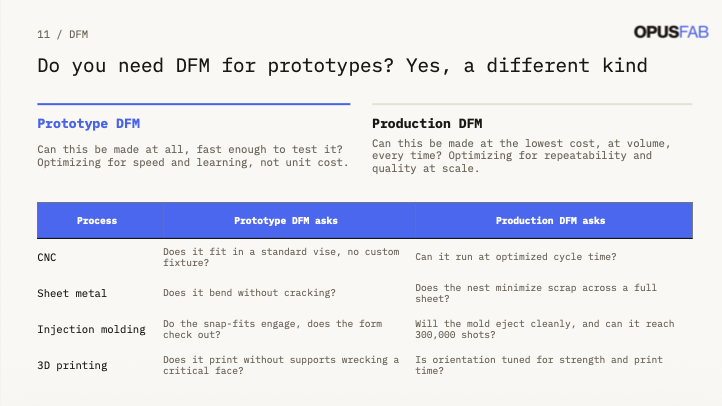
The questions differ by process. For CNC machining, prototype DFM asks whether the part fits in a standard vise without a custom fixture, while production DFM asks whether it can run at an optimized cycle time. For injection molding, prototype DFM asks whether snap-fits engage and the form checks out, while production DFM asks whether the mold ejects cleanly and can reach 300,000 shots.
Treating these as the same review, or skipping the prototype version entirely, is a common source of wasted iterations.
Get the Full Playbook
This post covers the highlights. The full Prototype Playbook includes the complete framework, worked cost examples, and the industry-by-industry breakdown of prototype loops.